The Red Light Is the Point: Why Shared Darkrooms Are Worth the Drive
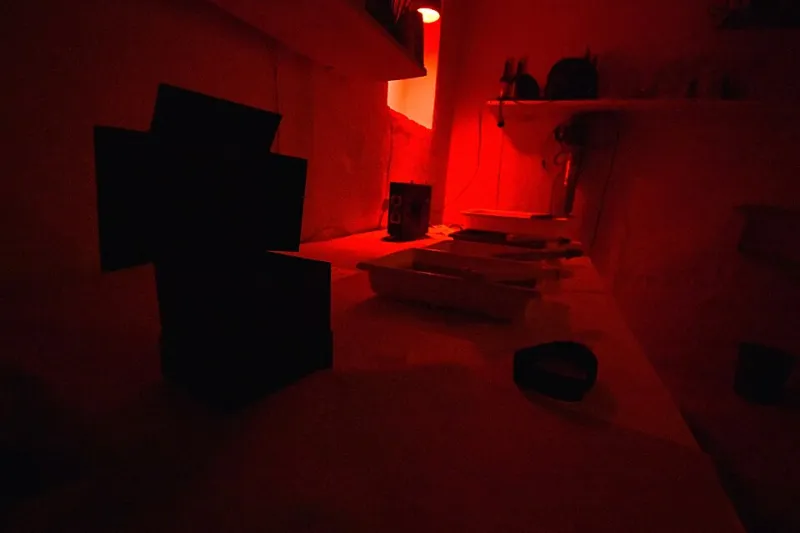
Photo: Jorge Rosendo Negroe Álvarez, CC BY-SA 4.0, via Wikimedia Commons
The first thing you give up in a darkroom is your phone, mostly because the light from it will fog your paper and partly because there's nowhere to look at it. You stand in the amber glow with your hands in a tray of developer, waiting for an image to surface. It arrives slowly, from nothing, and then all at once. Nobody claps. There is no counter ticking upward. Someone across the room is having a bad day and mutters at their test strip, and the timer beeps, and that's the whole event.
I've been thinking about that room a lot lately, while scrolling past the ninth AI-generated version of a diner at golden hour in a single week.
Nobody claps in the dark
Here's what I want to argue, plainly: community darkrooms are one of the last honest third places left in American cultural life, and we should be funding them like it's an emergency instead of treating them like a nostalgic hobby for people who own a lot of black turtlenecks.
A darkroom is not home. It's not work. It is not, and cannot be, a feed. It requires a shared space, shared chemistry, and shared time, and it produces almost nothing that can be optimized. You mix the developer. You wait. You get it wrong. You try again on Thursday because the room is only open on Thursdays, and by then you've had a thought about the crop.
There is no algorithm here. There's a light meter and a person who has been doing this since 1979 telling you that your negative is thin.
Chemistry is unimpressed by your engagement rate
The obvious objection is that analog photography is inconvenient, expensive, and slower than the alternative. Correct on all three counts. Film prices have climbed, chemistry isn't cheap, and every square foot of darkroom space is a square foot that a landlord would rather rent to a storage company. Running a shared darkroom is a logistical slog: ventilation, plumbing, chemical disposal, safelights that someone will inevitably forget to check.
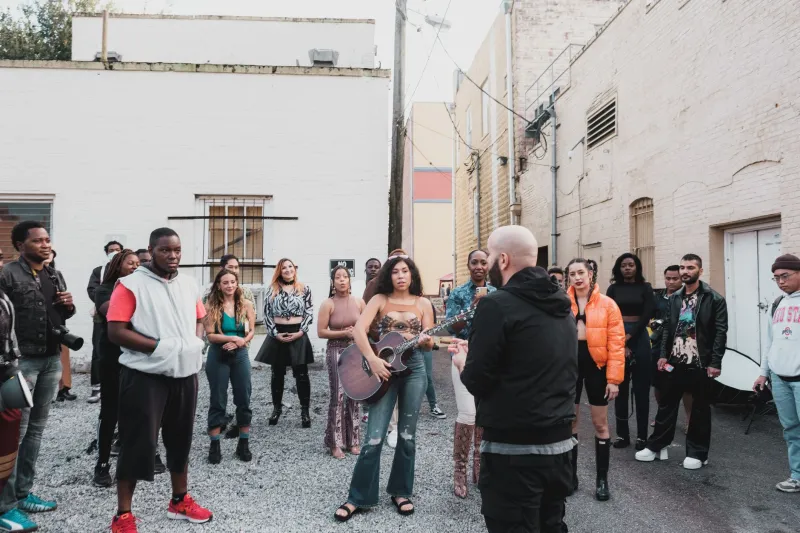
And yet people keep showing up. Go look at a community darkroom in a midsize city on a Tuesday and count the ages in the room. There's a retired newspaper photographer who still prints like it's 1994. There's a nineteen-year-old who learned about push processing from a video and has never seen a contact sheet made in person. There's a nurse who shoots one roll a month and prints two frames from it. They share a chemistry batch and a box of gloves and, crucially, they share a problem.
That's what makes it work. The room gives strangers something concrete to be confused about together, which is a far stronger social adhesive than a shared aesthetic.
The most intergenerational room in town
We talk constantly about how fractured cultural life has become — how young people and old people occupy completely separate informational worlds. A darkroom scrambles that. It is one of the few places where expertise is transferred by standing next to someone and watching their hands.
You cannot Google your way out of a light leak. You can, however, stand in a small room with someone who has seen a hundred of them and who will tell you, with real joy, exactly where to look. That kind of knowledge is fragile in a very literal way: it lives in people who are now in their seventies, and it dies with them unless there's a room where it can be handed off.
Algorithms are exceptional at matching people who already share interests. They're terrible at producing the accidental encounter — the retired photographer and the teenager, the neighbor and the stranger, the person who came in to use the enlarger and stayed to learn how to mix D-76.
Slow is the whole point
I keep hearing the same line about AI imagery: it democratizes creativity because now anyone can make a picture. Fine. But making a picture was never the hard part. The hard part is having something to say, and having a place to say it where you aren't being scored in real time.
The darkroom is built for experimentation with consequences. You ruin a print and it costs you four dollars and forty minutes. You learn to look at your own work without a like button telling you how to feel about it. You learn that a photograph is a physical object with weight and grain and a silver sheen that catches the light when you tilt it, and that this is a different thing than a file.
There is also, if we're being honest, a political dimension. Every image is now suspect. We're about to spend years arguing about what's real, and the darkroom is a place where the answer is checkable — where the negative exists, the paper exists, the chemistry left a stain on your sleeve.
What to do before the enlargers hit the dumpster
Community darkrooms are precarious. Many live inside art centers, public libraries, community colleges, and small nonprofits that run on memberships and grant cycles. When a lease ends, the equipment goes to a storage unit and then, eventually, to a dumpster, because enlargers are heavy and nobody has a garage big enough.
So here's the practical version of this argument. If you have an enlarger in a basement, donate it to a place with a sink and a safelight. If you have money, give it to chemistry and ventilation and a stipend for the person who mixes the chemicals. If you have a teenager, sign both of you up for a class. If you work at a library or a parks department, ask why there isn't one.
And if you have never been in a darkroom, go find one. Stand in the amber light for an hour. Watch something appear out of nothing. Leave your phone outside, and notice how long it takes before you stop reaching for it.
That feeling — the slow, unperformed, unshared-in-real-time act of making a thing — is the entire reason arts organizations exist. We've just gotten very good at forgetting it, and very fast at replacing it.