The Shelf Where Nothing Costs Anything
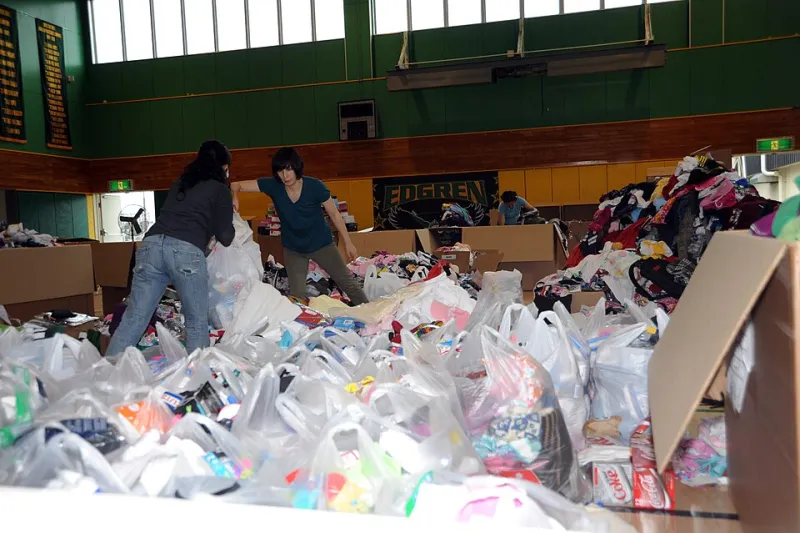
Photo: U.S. Navy photo by Mass Communication Specialist 1st Class Matthew M. Bradley, Public domain, via Wikimedia Commons
The line starts forming a few minutes before the roll-up door goes up: a middle school art teacher with a canvas tote, a retired man hunting one specific shade of burnt sienna, two teenagers who saw the place on TikTok and want to know whether the fabric is really free.
Behind the door is what a thrift store might look like if it went to art school. Half-used tubes of acrylic. Bins of upholstery swatches sorted by color. A cardboard box labeled CLAY (SLEEPING). A wall of frames nobody has wanted since 1998. And a hand-lettered sign that explains the entire operation in four words: take what you need.
Creative reuse centers have existed in the US since the 1970s, but the model has spread steadily over the past decade. The Scrap Exchange in Durham, Pittsburgh Center for Creative Reuse, MECCA in Cleveland, Arts and Scraps in Detroit — different names, same premise. Collect what businesses, schools, and households discard, sort it, and put it back into the hands of people who will make something out of it. Most run on a mix of tiny sales, donations, grants, and an unreasonable amount of volunteer labor.
A thrift store, a hazardous-waste program, and a clubhouse
Depending on the hour, a reuse center is any of those three things, which is exactly why funding one is so awkward. It isn't a charity in the traditional sense, though it serves plenty of people who can't drop $80 on supplies. It isn't a waste hauler, though several hold contracts to divert material from landfills. And it isn't a community center, though on a Saturday morning it absolutely functions as one.
That hybrid identity is the point and also the problem. Traditional funders find the model strange. Municipal contracts find it small. And rent finds it every month, on time, without mercy.
Where the stuff comes from
The intake list is more interesting than most people expect. Hardware stores hand over mis-tinted paint by the gallon — the customer rejected the color, it can't be resold, and in many states it can't legally go in the trash. Manufacturers donate discontinued colors and overruns. Film and theater productions drop off set dressing and fabric. Schools clear out storage closets during summer break. Print shops bring paper trimmings by the box. Households arrive with the contents of a garage.
Then there are the estate cleanouts, which are their own kind of heavy. An artist dies, and the family stands in a studio full of brushes, panels, and jars of medium, with no idea who could possibly want any of it. A reuse center says yes, loads the van, and spends three weeks deciding what's usable.
The hard part isn't collecting. It's sorting.
Every donation gets inspected, and the rules are stricter than shoppers realize. Nothing unlabeled. No aerosol cans. No solvents with illegible labels. No mold, no mildew, no mystery powder in a yogurt container. Nothing that looks like it could poison a toddler, because a good chunk of the inventory ends up in kids' programming.
Whatever gets rejected, the center often has to pay to dispose of properly, which is why the signage at the donation door is so blunt. Sorting is the bottleneck that determines whether a reuse center thrives or drowns: volunteers divide donations into bins by medium, shelves by color, and a free bin for the odd stuff that has no category but is too good to toss.
There's also inventory discipline, and it's brutal. A reuse center that accepts everything becomes a hoarding problem with better lighting. The good ones move stock constantly — rotate, discount, give away, recycle. The whole point is circulation, not accumulation.
Why free changes the room
Ask anyone who runs one of these places and they'll tell you the same thing: the supplies are the draw, but access is the product.
A tube of paint costs money, and money is a gate. Art teachers routinely spend their own cash on classroom supplies. Parents quietly decide a kid isn't 'artistic' because the good paper costs too much and the cheap paper buckles. Somebody who has wanted to try ceramics for six years never does, because a bag of clay plus a studio fee plus a firing fee adds up to a number that feels irresponsible.
Free materials don't just lower a price. They lower the stakes. There's a real difference between a classroom where every kid gets one sheet and a classroom with a bin and explicit permission to waste some. Reuse centers create the second kind of room.
And yes, the environmental case matters. Art supply waste is a small slice of the overall waste stream, but it's a visible one — the kind that makes people reconsider what they throw out. Every gallon of paint diverted is a gallon that didn't have to be manufactured, transported, and eventually landfilled.
What these places actually need
The list is unglamorous: a lease they can afford, zoning that doesn't treat a donation drop-off like an industrial hazard, staff who get paid, volunteers who are treated as more than free labor, and a city willing to sign a contract instead of just a proclamation.
Some municipalities now pay reuse centers to accept diverted material or to run paint collection for residents, which turns a scrappy nonprofit into actual infrastructure. That's the version of this story worth pushing for. The alternative is the familiar one: a beloved institution run by three exhausted people until the building sells.
The dignity of the free bin
What sticks with you isn't the shelving. It's the browsing. Nobody hands you a form. Nobody asks what you're going to make or whether you're good at it. You pick up a jar of pigment because the color is interesting, and then you have to figure out what to do with it — which is, more or less, how every artist starts.