The Room Was Always There. The Paperwork Wasn't.
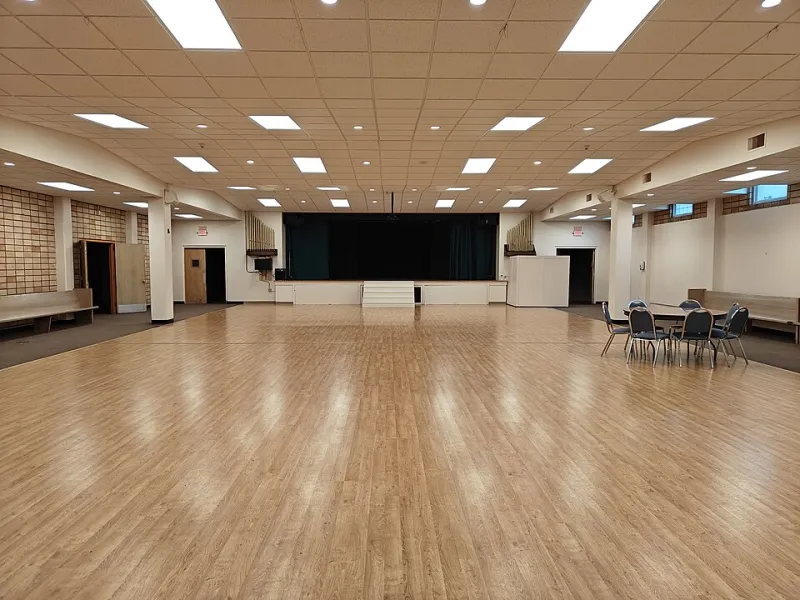
Photo: Chevsapher, CC0, via Wikimedia Commons
The hymn board in the basement hallway still lists last Sunday's numbers, and someone has never bothered to change them. Down the corridor, past the industrial kitchen and the folding tables stacked against the wall, a youth string ensemble is tuning. The room smells like burnt coffee and rosin.
This is a common scene now, in cities and small towns alike: a sanctuary built in 1923 to hold four hundred people, currently hosting about sixty on a Sunday, with a Christian education wing that has been mostly empty since the Reagan administration. Six days a week, that square footage just sits there, heated and insured and unused.
Meanwhile, the artists who want it can't afford anything else. Rehearsal space is expensive. Studio space is more expensive. A gallery that lets you hang work for a month without a deposit is a fantasy. So the match seems obvious — and it is, in the way that all obvious matches are obvious right up until someone asks about liability.
The deal is rarely a deal
Most of these arrangements aren't leases. They're facility-use agreements, month to month, sometimes with a handshake and a photocopied page. The rent varies wildly: free for a neighborhood group that meets twice a month, $50 a night for a theater company that needs the fellowship hall for six weeks, a suggested donation, or straight barter.
Barter is more common than you'd think. A printmaker repaints the hallway. A graphic designer rebuilds the church website. A dance troupe performs at the holiday fair every December and brings a hundred people through the door. One building committee chair described the arrangement to me, roughly, as: they get a room, we get a building that doesn't feel abandoned.
Utilities are the real rent, and the thermostat is the real negotiation. A congregation that keeps the heat at 62 all week has opinions about a group that wants it at 70 on Tuesday nights. The good arrangements put that in writing, which feels absurd until the first January heating bill arrives.
Insurance is the word that ends the conversation
Ask a pastor why their building is still locked six nights a week and the answer is rarely theological. It's coverage.
A congregation's policy typically covers its own ministries and customary activities. An outside group rehearsing in the fellowship hall may not be covered — especially if it has public performances, minors, power tools, kilns, or anything involving a scissor lift. Sometimes a rider on the church policy solves it. Sometimes the group needs its own general liability policy, which means incorporating, which means forming a board, which means a small theater company suddenly has more paperwork than a dental practice.
Then come the smaller unanswerables. Who's responsible if a kid falls down the outside stairs? Who holds the keys? Who shuts off the coffee maker? Why is there a bucket in the choir room? The groups that last are the ones that answer those questions in advance, name one contact person on each side, and hand over a certificate of insurance without being asked twice.
The calendar is a contact sport
A church building isn't a blank venue. It's a schedule with stained glass.
Wednesday is the food pantry. Thursday is AA. Saturday afternoon is a rental for a quinceañera, which is one of the few reliable revenue streams left. There's a funeral reception on short notice, a Christmas pageant in the sanctuary, and a trustees meeting that somehow always lands on the night the dance company needs the big room.
What works, according to people who run these buildings, is unglamorous: one shared calendar that everyone can actually see, one coordinator with authority to say no, and an explicit priority list so nobody has to relitigate whose event outranks whose every month. Groups that treat the church calendar as sacred survive. Groups that assume they can move things tend to get a polite email in February.
The negotiations nobody writes down
Here's where it gets delicate. Congregations are inviting strangers into a space that carries a lot of meaning, and some of that meaning is not negotiable for them.
A gallery show with nudity. A play that gets political. A band whose lyrics a trustee's grandmother will hear through the floor vents. In practice, a pastor ends up as a curator, whether or not they wanted the job, and the line often lands somewhere practical: fine in the fellowship hall, not in the sanctuary.
Artists have their own wariness. Nobody wants to be a captive audience for evangelism, and no one wants to find out at the third rehearsal that attendance at a service is now part of the arrangement. Some congregations are refreshingly direct about it — hospitality is part of their mission, and they'd like the neighborhood to know them. Say that out loud in the first meeting and the relationship tends to be healthier for it.
What good arrangements have in common
A written agreement, even a one-pager. A named person on each side. A cleanup checklist that everyone signs off on. A no-surprises rule about big public events. A clear way to end things if it stops working. And something exchanged, even if it's $25 a night — symbolic payment changes the dynamic from charity to partnership, and partnership is what lasts.
Also, donuts at the trustee meeting. This is not a joke. The building committee is where these decisions get made, and they are volunteers who are tired.
A building heated for forty people
There's a bigger story here about preservation, neighborhood anchor institutions, and what happens to America's aging church buildings as attendance keeps sliding. Some cities make it hard: a church in a residential zone is often a legal nonconforming use, which means public events can trigger parking complaints from neighbors who never complained about Sunday mornings. A few municipalities have smoothed that path deliberately, because they'd rather have a rehearsal room than a vacant building.
But the argument doesn't need to be complicated. A building heated all winter for forty people might as well hold a choir on Tuesday. The piano sounds through the stained glass onto a sidewalk where someone is walking past, someone who has lived on that block for eleven years and has never once been inside.
That's the whole transaction, really. The room was always there. It just needed a key and a signature.